


The “end-of-the-month” feeling is brutal! (For me it’s even middle-of-the-month! 😅)
Your salary came in. You paid the bills. Nothing major happened. Yet somehow, your bank balance is already looking suspiciously low.
Usually, it isn’t one huge purchase causing the damage. It’s the tiny stuff:
- ₹300 food delivery orders
- Random Amazon/Flipkart purchases
- “I’ll cancel later” subscriptions
- Small UPI payments you barely remember
- Coffee, snacks, cabs and impulse buys
Each one feels harmless. Together, they quietly eat your salary. Manually tracking every expense is boring. Ignoring your spending is worse. That’s why expense tracker apps have become so popular in India.
But there is a problem: current “best expense tracker” lists online are outdated. Some recommend apps that no longer exist. Others recommend apps that have basically turned into loan-selling machines.
For an era of 2026 – 2027, a good finance app needs to do more than record expenses.
It should be:
- Privacy-first
- Easy to understand
- Visually clean
- AI-powered
- Low effort
- Useful even when your attention span is running on 3% battery
To ease your life, we have researched the whole internet thoroughly to tell you what seems the best expense tracker overall. This list looks at 11 popular expense tracker apps in India and explains why each app is actually good.
How we evaluated these apps
We looked at three things most “best of” lists blur together:
- How each app gets your data: manual entry, SMS parsing, bank-linking, etc.
- How deep the AI actually goes: forecasting, scenario planning, proactive alerts, etc.
- What it costs you in money or in access to your financial data.
____________________________________
1. expenseOS — Best Overall for AI-Powered Money Management
Best for: Gen Z, AI users and people who want their finances to actually talk back. Most expense trackers are basically digital notebooks. expenseOS tries to be something different.
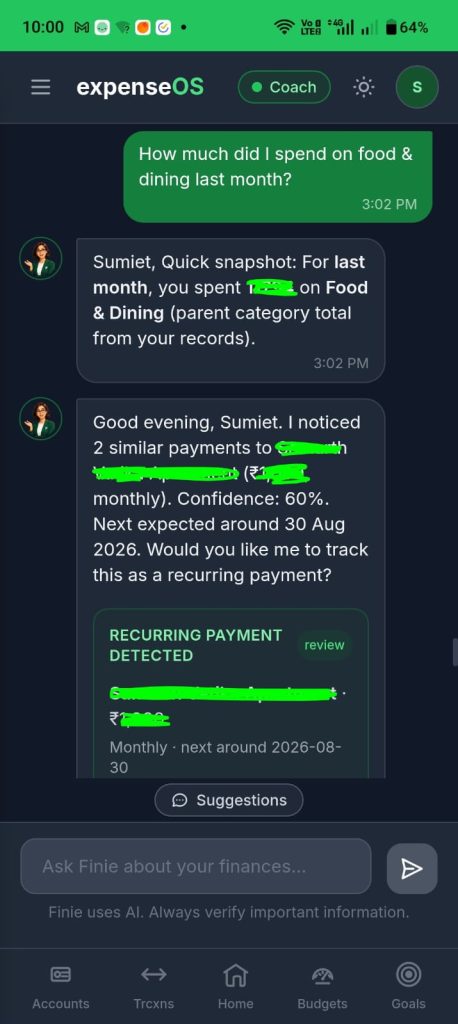
Instead of only telling you where your money went, expenseOS tries to tell you what is likely to happen next. Its AI assistant, Finie, works like a financial copilot. You can simply ask questions in normal language: “How much did I spend on food & dining this month?” Or: “Where did my money go last month?”
Instead of digging through filters and charts, Finie gives you the answer directly, along with useful visualizations.
What makes expenseOS more than just an expense tracker app
The deeper an app’s automation goes, the more access it needs to your bank — and the deeper an app’s AI goes, the more it tends to assume you’ve already linked a bank or opened a new account. Almost nothing on this list gives you serious financial planning — forecasting, scenario modelling, proactive warnings — without asking for banking access first. expenseOS was built to break that trade-off.
expenseOS is a manual-first platform (with receipt-photo scanning and quick-add shortcuts doing the heavy lifting so “manual” doesn’t mean “slow”) powered by an AI copilot named Finie that goes considerably further than categorisation. Here’s what actually sets it apart — including where it’s honestly still catching up.
The “Don’t Make Me Think” UI.
Borrowed from Steve Krug’s classic UX principle of the same name: a good interface shouldn’t need a manual. expenseOS’s dashboard loads everything — net worth, budget meters, Finie (AI) insights, recent transactions, active goals — from a single call, typically under 1 second. The app is elegantly structured into ~7 pages: Accounts, Transactions, Home (dashboard), Budgets, Goals, Analytics and Profile.
During app onboarding, Finie asks 3 quick questions and generates a real, working budget plan in under a minute, before you’ve entered a single transaction. No blank screens, no “start by creating your first category” busywork.
Finie (AI) actually knows your money — not generic advice.
Ask Finie “how much did I spend on food last month” or “am I on track for my Emergency Fund goal” and it queries (text to SQL) your real transaction history (database) and answers with your actual numbers, always citing what it’s basing the answer on.
It supports plethora of query types out of the box, and comes in three personality modes (Coach, Analyst, Buddy). Most important: the app architecture is locked to read-only access on your data — so it structurally cannot write to your database, even if something upstream were compromised.
GIGO (Gold In, Gold Out || OR || Garbage In, Garbage Out).
This is the core philosophy behind expenseOS. Every rupee you log in expenseOS is one you put there intentionally — not an SMS-parsing guess, not a bank-feed transaction with a cryptic merchant code attached.
The better your inputs are:
Better data → Better analysis → Better decisions
Simple, but surprisingly important.
The accuracy is exactly what an AI model needs to be genuinely useful instead of “generically” useful. Feed it clean, complete data, and its forecasts, budgets and warnings get sharper. Feed it garbage — like an auto-import that missed your cash spending or mislabelled a merchant — and even the smartest model produces garbage advice with total confidence.
Ask Your Money Questions Like You’re Talking to a Person.
Instead of navigating five menus to find your food spending, just ask: “How much did I spend on Zomato this month?” Or: “Which category did I spend the most?”
Or: “Can I afford my upcoming bills?”
Finie uses natural-language processing to understand the question and query the financial database. The result can include:
- A simple explanation
- Numbers
- Charts
- Follow-up questions
It’s basically ChatGPT-style interaction for your personal finances!
Finie warns you before the damage is done, not after.
Traditional expense trackers tell you when something has already gone wrong. expenseOS tries to warn you beforehand. Its prediction engine analyses your spending and expected cash flow. If your upcoming balance looks risky, you can get a warning several days before a recurring payment is likely to fail. That’s a much more useful notification than: “Oops. Your payment failed.” Thanks, expenseOS. Very helpful!
Additionally, its anomaly engine flags spending that’s an unusual multiple of your normal pattern in near real time, detects the classic “spend it all in week one” spike right after salary day, and runs Monte Carlo simulations to warn you about your forgotten goals.
Budgets that adjust themselves (adaptive).
Real life doesn’t follow plans. You may spend less on travel but suddenly spend more on groceries. A fixed ₹8,000 grocery budget doesn’t magically become realistic because Excel says so. expenseOS analyses recent spending patterns and can suggest budget adjustments during the month. Instead of: Budget → Fail → Give up the goal is: Budget → Monitor → Adjust → Continue
Subscription Creep Detection hardcoded.
Subscriptions have a sneaky habit: ₹299 → ₹329 → ₹349 You barely notice. expenseOS can monitor recurring transactions and identify unusual increases. So instead of discovering the price increase six months later, you get a reason to ask: “Wait… why am I paying more for this?” That tiny alert could save more money than another fancy chart ever will.
Machine Learning planning tools most trackers skip entirely.
- A What-If simulator for job loss, a big purchase, or an extra EMI payment.
- A FIRE calculator with life-event templates for weddings, a new baby, or buying a home.
- A debt payoff planner that runs both the avalanche and snowball methods side by side so you can see which actually saves you more.
- A future cashflow/net worth prediction based on your current pace.
- The Goal-completion odds calculated via Monte Carlo simulation rather than a straight-line guess.
None of the other apps in this list offer this depth of forward-looking planning in a personal tracker.
Built around India’s actual financial mechanics, not adapted to it.
EMI detection with full amortisation math the moment a recurring loan payment is spotted. Credit card reminders that respect your real billing cycle and grace period, not a generic “pay your bill” nudge. Budget templates (50/30/20, Zero-Based, envelope-style) that fit ₹-denominated, India-specific spending patterns from day one.
Family Mode Without Giving Up Your Privacy.
Managing money with a partner or family member can get awkward. You want shared goals. But you don’t necessarily want your children seeing each other’s personal transactions and have a fight thereafter. 👊
Family Mode separates the two. Family members can contribute to:
- Shared expenses
- Household goals
- Common budgets
- Shared financial metrics
while keeping personal financial information private. So, you get: shared household finances + individual privacy instead of: “Here’s my password. Please don’t judge my Zomato history.” 😅
To be fair — the honest caveats (Cons).
expenseOS launched in 2026, so it doesn’t have Axio’s ten-million-user track record or Moneyview’s decade of SMS-parsing refinement yet (see below list). Manual-first entry, even with quick-add shortcuts, is genuinely not for someone who wants to never think about their expense tracker at all — if that’s you, Moneyview or Axio will serve you better. And direct bank sync (while on the roadmap) isn’t live yet on expenseOS — today it’s manual entry, receipt-photo scanning and CSV import only. If auto-import from your bank is non-negotiable for you right now, wait or pair expenseOS with your bank’s own statement export in the meantime.
What you get in exchange: an AI that never had to guess, because you never gave it anything to guess about — and a clean, “don’t make me think” interface built around insights, not just a pie chart of your last thirty days.
Apart from the generous “Free Forever” tier, Pro plans start from ₹299/month with a 7-day Pro trial.
____________________________________
2. FinArt — Best for Privacy + Automatic SMS Tracking
Best for: People who want automation but don’t want to give an app their bank password.
FinArt takes a privacy-first approach. Instead of connecting directly to your bank account, it can read financial SMS, emails and bank notifications on your device and use that information to build your expense history.
Its Private Mode goes even further by keeping financial information on your phone.
It also supports family syncing, which can be useful for couples managing household expenses.
Pros | Cons |
Strong privacy: No bank login required. | iPhone limitations: SMS-based tracking is heavily restricted on iOS. |
Ad-free: No constant credit-card or loan promotions. | Paid after trial: Only a short free trial is available. |
Family sync: Useful for shared household budgets. | — |
___________________________________
3. Wallet by BudgetBakers — Best for Serious Analytics
Best for: Data nerds, freelancers and spreadsheet lovers.
Wallet is basically the power-user option.
It provides:
- Detailed reports
- Custom dashboards
- Charts
- Multiple currencies
- Multiple accounts
- Web access
- Detailed categorization
If you enjoy analysing your finances in detail, Wallet can be extremely powerful.
However, Indian bank integrations can be less reliable than users might expect, particularly when Account Aggregator connections experience issues.
Pros | Cons |
Deep analytics: Excellent reporting and dashboards. | Indian bank sync can be unreliable: Connections may require troubleshooting. |
Multi-currency: Great for international workers and travellers. | Freemium restrictions: Important features require payment. |
Web interface: Excellent for large-screen financial reviews. | — |
___________________________________
4. jUMPP — Best for People Who Want Everything in One App
Best for: Super-app fans.
Some people want one app for everything. jUMPP is built for exactly that.
You can use it for:
- UPI payments
- Bill payments
- Expense tracking
- Investments
- Digital gold
- Mutual fund SIPs
- Fixed deposits
- Insurance
- Loans
Its AI assistant, jAI, also provides personalized financial insights and supports multiple Indian languages.
The downside? There is a lot happening on the screen. If you only want to answer “Where did my ₹5,000 go?”, this can feel like bringing a Swiss Army knife to open a packet of chips.
Pros | Cons |
All-in-one: Payments, investments and money management in one place. | Can feel cluttered: Too much functionality for simple expense tracking. |
AI assistant: Analyses spending across the ecosystem. | Heavy product promotion: Loans and insurance can appear prominently |
Zero-balance account: Digital account opening. | — |
____________________________________
5. Axio — Best for BNPL & Credit Tracking
Best for: People who use credit cards, BNPL or pay-later services.
Axio was previously known as Walnut, one of India’s early SMS-based expense trackers.
Its strongest feature is still automatic transaction tracking through SMS.
But Axio has moved much deeper into credit and lending.
It can track:
- BNPL purchases
- Credit-related transactions
- Spending
- Credit scores
- Fixed deposits
Pros | Cons |
Excellent SMS parsing: Particularly good with Indian bank messages. | Credit-heavy: Loan and pay-later products are prominently promoted. |
BNPL tracking: Helps you see delayed payments more clearly. | Android-focused: SMS automation doesn’t work the same way on iOS. |
Free core tracking: Useful for students and budget-conscious users. | Data/privacy concerns: Financial data may be used for credit-related services. |
____________________________________
6. Jupiter Money — Best for Automated Saving
Best for: Young professionals who want their banking and saving automated.
Jupiter isn’t really just an expense tracker. It’s a digital banking platform.
Because transactions happen through its own banking ecosystem, transaction tracking can be much cleaner than SMS-based systems.
Its Pots feature is particularly useful.
You can automatically move money toward different savings goals when your salary arrives. For example:
Salary → Rent → Investments → Emergency Fund → Spending Money
This removes the need to rely entirely on willpower.
Pros | Cons |
Accurate transaction tracking: Direct banking integration. | Requires a new bank account: You need to complete KYC and use its banking ecosystem. |
Automatic saving: Pots can enforce savings goals. | Limited external tracking: Other bank accounts and cash spending may not be tracked perfectly. |
Modern UI: Fast and visually clean. | — |
____________________________________
7. Moneyview — Best for Hands-Off Expense Tracking
Best for: Android users who want almost zero manual work.
Moneyview has been around since 2014 and built its reputation around automatic SMS tracking. Once installed, it can analyse your existing bank SMS messages and reconstruct your financial history. So instead of entering hundreds of old transactions manually, you can get a usable history quickly. It also detects bill due dates.
The big catch? Moneyview’s business model is heavily connected to personal lending.
Pros | Cons |
Almost zero setup: Historical transactions can be reconstructed automatically. | Loan-heavy: Lending promotions can interrupt the experience. |
Bill reminders: Helps avoid late-payment charges. | Android-focused: SMS automation isn’t available in the same way on iOS. |
Mature SMS algorithms: Strong understanding of Indian bank messages. | – |
___________________________________
8. ET Money — Best for Turning Savings into Investments
Best for: People who want to move from budgeting to investing.
ET Money approaches personal finance from a different angle.
The idea is simple:
Track spending → Find surplus → Invest the surplus.
It combines expense tracking with investment products such as:
- Mutual funds
- SIPs
- Tax-saving investments
- Portfolio management
Its AI-powered ET Money Genius also provides investment-related recommendations.
Pros | Cons |
Strong investment ecosystem: Easy transition from budgeting to investing. | Basic expense tracking: Not as detailed as dedicated expense trackers. |
Investment intelligence: AI-powered portfolio insights. | Product-focused: Investment recommendations can become distracting. |
___________________________________
9. Goodbudget — Best for the Envelope Budget Method
Best for: People who want strict budgeting and don’t mind manual work.
Goodbudget uses an old-school idea with a digital interface: the envelope method.
Imagine you have ₹50,000.
You divide it into virtual envelopes:
- Rent — ₹15,000
- Food — ₹8,000
- Transport — ₹5,000
- Entertainment — ₹3,000
- Savings — ₹10,000
- Other — ₹9,000
Every expense comes out of its relevant envelope. There is no SMS automation. And that’s intentional. The small amount of friction forces you to think before spending.
Pros | Cons |
Privacy-focused: No bank or SMS connections required. | Very manual: You have to enter transactions yourself. |
Behavioural benefit: Makes spending more conscious. | Requires discipline: Missing entries can mess up your budget. |
Cross-platform: Useful for couples and households. | — |
____________________________________
10. Monefy — Best for Extremely Fast Manual Tracking
Best for: Minimalists.
Monefy has one goal: Record an expense in seconds.
Open the app. Tap Food. Enter ₹250. Done. No complicated dashboards. No AI. No giant financial ecosystem. Just simple expense logging.
Pros | Cons |
Very fast: Minimal taps and menus. | Limited features: No advanced AI or predictive analytics. |
Easy to understand: Visual icons make categories obvious. | Manual: You still need to remember every transaction. |
__________________________________
11. Self Expense Tracker — Best for 100% Local Storage
Best for: Maximum privacy.
Self Expense Tracker keeps things extremely simple. Your financial data stays on your device.
There is NO:
- Bank integration
- SMS tracking
- Financial AI
- Marketing analysis
You can manually back up your data to your own Google Drive when needed.
Pros | Cons |
Strong data ownership: Your financial information isn’t stored on the developer’s servers. | No automation: Everything is manual. |
Offline: Doesn’t depend on banking APIs. | Basic interface: No advanced AI or predictions. |
— | No third-party integrations: Fewer external attack surfaces. |
____________________________________
Final Verdict
We’re entering a phase where financial apps can potentially understand patterns, predict problems and help users make decisions. But more features don’t automatically mean a better app.
The real question is: Does the app make managing money easier, clearer and less stressful?
For privacy-first users, FinArt is compelling.
For strict budgeting, Goodbudget is excellent.
For investment-focused users, ET Money makes sense.
For deep financial analysis/visuals, Wallet is powerful.
For automated banking, Jupiter Money is worth considering.
But if you want an AI-first expense tracker that combines automation, conversational analysis, predictive alerts and a low-cognitive-load user interface (UI) with a great user experience (UX), expenseOS is the most interesting option in this comparison.
The future of personal finance probably isn’t another spreadsheet.
It’s a financial assistant that quietly watches the numbers, spots problems early and tells you what actually matters. And honestly, that’s much more useful than finding out on the 16th that you somehow spent ₹14,700 on “small things.”
Screenshots from expenseOS.app

Finie Chat message 1
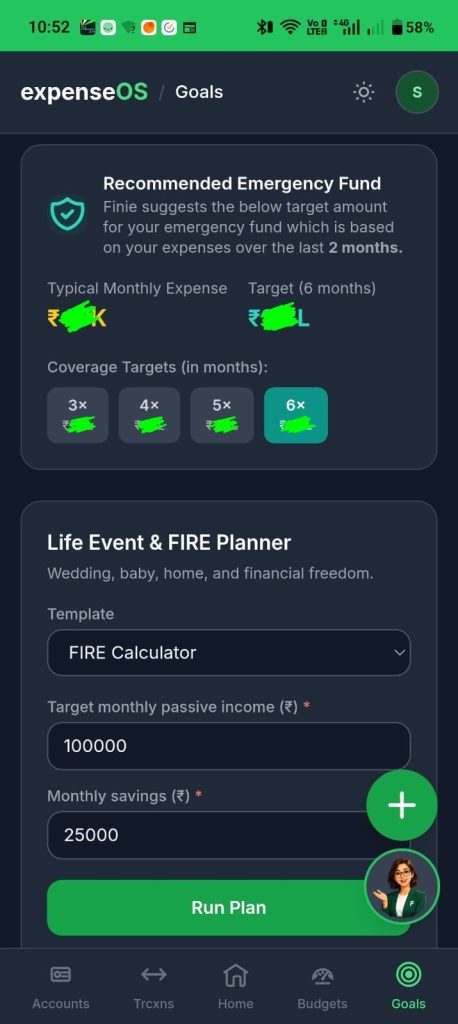
Emergency Fund
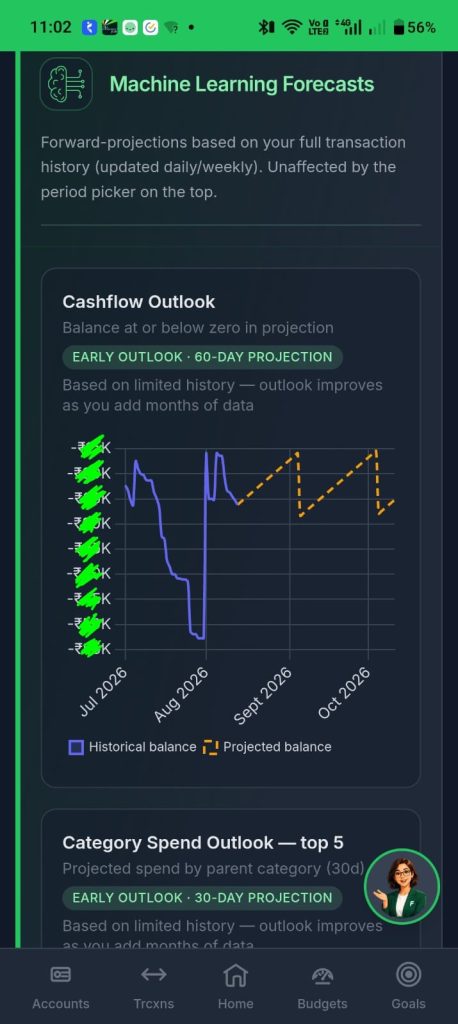
Machine Learning in expenseOS.app
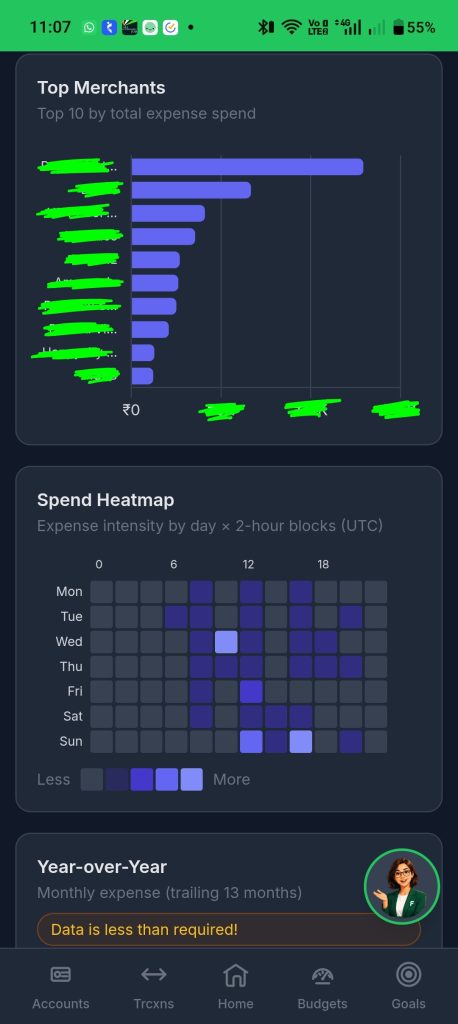
Analytics on expenseOS